
PlinkoX is a drop-style Baji365 casino game where a ball is released from the top of a peg board and settles into a payout slot with a defined multiplier. The outcome is resolved in a single sequence, and the payout is typically calculated by multiplying the stake by the multiplier associated with the final landing slot. While the visual presentation resembles a physics-driven board, most online implementations determine the result through a randomization process and then animate the drop to match the selected outcome. This structure supports fast settlement, clear verification, and adjustable variance through selectable risk settings.
This article explains PlinkoX from a mechanics-first perspective, focusing on board layout concepts, risk tiers, multiplier distribution, and settlement clarity. The objective is to support consistent interpretation of outcomes by showing how volatility is shaped by configuration choices rather than by perceived streak behavior.
PlinkoX Core Gameplay Loop And Drop Resolution

PlinkoX typically begins with selecting a stake and choosing a board configuration such as rows or levels. After settings are confirmed, a ball is dropped from a chosen position at the top of the board. The ball travels downward, deflecting off pegs, and eventually lands in one of several slots at the bottom. Each slot has an assigned multiplier, and the result is settled immediately after the landing position is registered.
The settlement calculation is usually straightforward: the stake is multiplied by the landing-slot multiplier to determine the credited payout. If the multiplier is less than 1.0x, the credited payout can be smaller than the stake. If the multiplier is greater than 1.0x, the credited payout exceeds the stake. The exact multiplier table depends on the selected board settings and risk tier.
Because PlinkoX resolves quickly, it supports frequent decision cycles. That speed makes configuration clarity important, as changing risk tier or row count can materially alter the distribution of multipliers from one drop to the next.
See more:
- Penalty Roulette: How to Play and Win at Penalty Roulette
- Quack Squad: Discover How to Play and Win in Quack Squad Game
Board Layout, Rows, And How Outcomes Are Distributed
A defining configuration in PlinkoX is the number of rows or pegs the ball travels through. A board with more rows typically creates more possible landing slots, which can widen the multiplier distribution and increase the range of potential outcomes. A board with fewer rows typically has fewer slots, which can narrow outcome variety.
In a physical plinko board, central slots tend to be reached more frequently than edge slots due to the cumulative effect of left-right deflections. Online PlinkoX implementations often mirror that distribution, with medium multipliers appearing in central slots and extreme multipliers placed near the edges. This creates a probability profile where extreme multipliers are rarer, while modest multipliers occur more frequently.
Row count affects the shape of this distribution. More rows can make edge outcomes rarer while increasing the number of intermediate outcomes. Fewer rows can make edge outcomes less rare relative to the board, but typically with a different multiplier table that preserves overall balance.
See more:
- Neptune Bingo: How to Play Neptune Bingo and Increase Your Chances of Winning
- Peek Baccarat: How to Play Peek Baccarat and Win More with Expert Strategies
- American Blackjack: Expert Tips for Winning at American Blackjack
Risk Tiers And What They Change
PlinkoX commonly offers selectable risk tiers, often described as low, medium, and high. Risk tiers do not change how the game concept works, but they change the multiplier table assigned to the slots. In low risk, the multiplier table is typically more compressed, with fewer extreme highs and fewer extreme lows. In high risk, the multiplier table is typically more spread out, with larger potential multipliers at the edges but also more low multipliers in central or near-central positions.
Risk tier selection therefore changes variance. Low risk tends to produce more frequent modest outcomes, while high risk tends to produce wider swings due to rare high multipliers and more frequent low multipliers.
| Risk Tier | Multiplier Spread | Typical Outcome Profile |
| Low | Narrower | More frequent mid multipliers |
| Medium | Moderate | Balanced mix of mid and edge outcomes |
| High | Wider | Rarer high multipliers, wider swings |
Because the risk tier changes the multiplier table, the same landing slot position can represent a different multiplier under different risk settings. This is why clear visibility of the active risk setting is essential for accurate interpretation.
Multiplier Tables, Payout Calculation, And Net Results
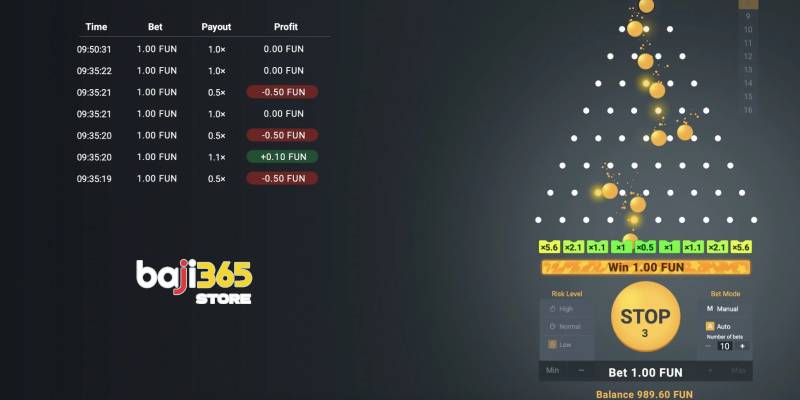
PlinkoX payout calculation is typically multiplier-based. The landing multiplier is applied to the stake to determine the credited amount. The net result for the drop is the credited payout minus the original stake. Multipliers greater than 1.0x produce positive net results for that drop, while multipliers below 1.0x produce negative net results.
Multiplier tables are typically displayed on the board itself, with each slot labeled. Some versions also highlight the current set of multipliers based on selected risk tier and row count. This visualization supports verification because it allows the landing position to be matched directly to the stated multiplier.
Because PlinkoX can have many multipliers, it is useful to interpret the board as a distribution rather than as a set of isolated outcomes. Central slots often carry lower-to-mid multipliers and occur more frequently, while edge slots often carry higher multipliers and occur less frequently. High risk configurations typically make edge multipliers higher and central multipliers lower, widening net result dispersion.
See more:
- Roulette and Blackjack: How to Master Roulette and Blackjack for Maximum Wins
- Game Shows: Top Game Shows You Can Play and Win Big
- Anmingo Rules: Complete Guide to Anmingo Game Rules and How to Play
Volatility Drivers And Session Variance
PlinkoX volatility is driven by the multiplier distribution and by how often drops are repeated. High risk and high row-count boards often increase variance by expanding the gap between common outcomes and rare outcomes. Lower risk settings generally reduce variance by compressing the distribution.
Key volatility drivers include:
- Risk tier: wider multiplier tables increase swing magnitude.
- Row count: more slots can widen distribution and reduce edge hit frequency.
- Stake sizing: larger stakes increase swing magnitude without changing probabilities.
- Decision frequency: rapid repeated drops can increase exposure over short time periods.
Short-run sequences can be misleading because rare edge outcomes can cluster or be absent over long stretches. The correct interpretation is that each drop is an independent event under standard randomization. A run of mid multipliers does not imply an edge outcome is due, and a sudden high multiplier does not imply a trend.
See more:
- Poker: Learn How to Play Poker and Improve Your Winning Strategy
- Andar Bahar: Ultimate Guide to Playing Andar Bahar and Winning Big
- Teen Patti: Tips and Tricks to Win at Teen Patti Every Time
Autoplay, Drop Position Choices, And Execution Settings
Some PlinkoX implementations allow autoplay, repeating drops with the same stake and risk settings. Autoplay does not change the outcome distribution, but it increases decision frequency and can accelerate exposure. Session controls such as stop-loss or take-profit limits, when present, act as pacing tools rather than as probability modifiers.
Drop position can also be selectable. In many online plinko designs, the drop position choice is primarily a visual preference because the underlying outcome is determined by the randomization process and then animated. If the platform treats drop position as a genuine parameter, it should be stated explicitly in the rules. Clear rule disclosure is therefore important for interpreting whether drop position changes probabilities or is purely cosmetic.
See more:
- Live Games: Experience the Most Exciting Live Casino Games Online
- Slots: Explore the Best Slot Games and Win Big Today
- Live Crazy Time: A Complete Guide to Playing and Winning at Live Crazy Time
Settlement Records, Verification, And Transparency

PlinkoX is easiest to verify when the interface provides a clear record of the stake, the selected risk tier, the selected row count, the landing multiplier, and the credited payout. A history log can support reconciliation when multiple drops occur quickly, allowing the session to be reviewed in terms of multipliers hit and net outcomes.
Transparency is strongest when the board displays the active multiplier table and highlights the final landing slot. This direct mapping reduces ambiguity because the multiplier is visible at the moment of settlement and can be confirmed against the board labels.
See more:
BAJI365 Context For PlinkoX Presentation
On baji365, PlinkoX is typically presented with clearly labeled risk tier controls, visible multiplier tables that update with configuration changes, and consistent outcome history displays intended to support reliable interpretation of landing-slot settlement and credited payout calculations.

CEO Dominic Amelia (born 1990) is the Chief Executive Officer of baji365, a Bangladesh-focused online entertainment platform providing live cricket data and digital gaming content. With years of experience in content strategy, platform operations, and digital brand development, Dominic Amelia is recognized for her leadership in building transparent systems and driving sustainable growth for baji365.
Contact Info:
CEO Dominic Amelia
Website: https://baji365.store/ceo-dominic-amelia/
Phone: +8801885206557
Address: 20 Shahid Fazlul Haq Rd, Dhaka 1212, Bangladesh
Email: baji365.store@gmail.com
#baji365 #baji365ceo #dominicamelia #bangladeshceo #ceodominicamelia #digitalplatform #cricketcontent #onlineentertainment #brandleadership #techleadership